import numpy as np
import matplotlib.pyplot as plt
from sklearn.datasets import make_blobs
from ood_detection.core import OODMetricOOD Detection
A library to detect out-of-distribution (OOD) data points using the feature embeddings and it’s the corresponding label
This library is used for OOD Detection where a model encounters new classes at test time that were not seen during training. The goal is to detect that such inputs do not belong to any of the training classes.



Install
pip install ood_detectionor
conda install -c yashkhandelwal ood_detectionExample Usage
# example dataset
n_samples = 1000
n_centers = 10
n_features = 1024

x, y = make_blobs(n_samples=n_samples, n_features=n_features, centers=n_centers, random_state=0)
# using the last 5 cluster as the test and rest as train
train_embedding = x[np.where(y < (n_centers - 5))]
train_labels = y[np.where(y < (n_centers - 5))]
test_embedding = x[np.where(y >= (n_centers - 5))]
test_labels = y[np.where(y >= (n_centers - 5))]ood = OODMetric(train_embedding, train_labels)
in_distribution_rmd = ood.compute_rmd(train_embedding)
ood_rmd = ood.compute_rmd(test_embedding)plt.hist([in_distribution_rmd, ood_rmd], label=["In Distribution", "OOD"])
plt.legend()
plt.show()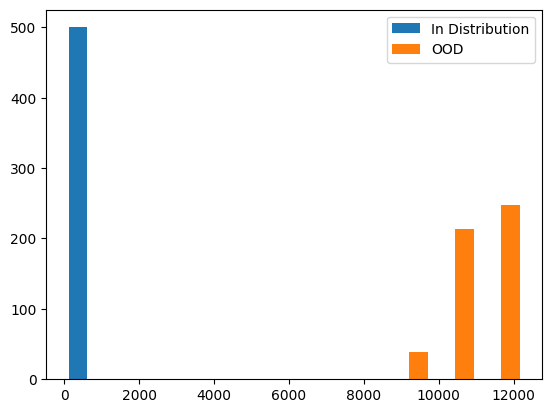
Built using NBDev
This OOD Detection library was built in a jupyter notebook with proper documentation and test cases. These test cases are verified before they are published to GitHub Pages, PyPi, Conda, etc.
I’ve written down a NBDev Tutorial explaining the thought process of Jeremy Howard and the folks at FastAI behind building it. The tutorial covers how to get started, important functions, and a description of those I used with the issues I faced while exploring the tool for the first time.
Acknowledgements
Special thanks to Yugam Tiwari for explaining the code he has written for the OODMetric and for helping me with packaging the library.
Thanks to Soma Dhavala for coming up with the idea to prepare NBDev Tutorial and helping with the initial reading and exploration material.